
Transparences liquides
10.09 — 6.12.2026
Réunissant quatre artistes contemporains, l'exposition Transparences liquides interroge les conditions de notre perception visuelle face aux flux d'images actuels. Entre l'espace, la durée et l'attention, elle déplace subtilement les modalités du voir pour explorer la manière dont les images configurent notre regard et nos structures de pensée.
Réalisée par Francesco Biasi et Nathalie Giraudeau, Transparences liquides a été présentée au CPIF (Centre Photographique d’Ile-de-France) du 25 janvier au 22 mai 2026.
en
Bringing together four contemporary artists, the exhibition “Transparences liquides” questions the conditions of our visual perception in the face of today's flow of images. Navigating space, duration, and attention, it subtly shifts the modalities of seeing to explore how images shape our gaze and our structures of thought.
Curated by Francesco Biasi and Nathalie Giraudeau, Transparences liquides was presented at the CPIF (Centre Photographique d’Ile-de-France) from January 25 to May 22, 2026.
nl
De tentoonstelling Transparences liquides brengt vier hedendaagse kunstenaars samen en bevraagt de voorwaarden van onze visuele perceptie in het licht van de huidige beeldenstroom. Tussen ruimte, duur en aandacht verschuift de expositie op subtiele wijze de modaliteiten van het kijken, om te onderzoeken hoe beelden onze blik en onze denkstructuren vormgeven.
Gecureerd door Francesco Biasi en Nathalie Giraudeau was Transparences liquides van 25 januari tot 22 mei 2026 te zien in het CPIF (Centre Photographique d’Ile-de-France).
© Emmanuel Van der Auwera, Memento 59 (Capitol Black)(détails), 2025, tirage sur plaques offset ayant servi à l’impression de journaux, 132 × 288 x 3 cm, courtesy de l’artiste et de la galerie Harlan Levey Projects (Bruxelles)
Transparences liquides
Anne-Camille ALLUEVA
À une époque où la majorité des images que nous consommons sont calculées et rétroéclairées, les écrans se sont imposés comme les interfaces permanentes de notre quotidien. Cette familiarité invisible nous fait souvent oublier la médiation qu’ils imposent dans la formation de notre regard.
C’est précisément au cœur de ces enjeux qu'Anne-Camille Allueva développe sa recherche plastique pour Transparences liquides. À travers un geste fort, l'artise isole l’une des strates techniques de nos écrans — le filtre polarisant — pour en révéler le rôle crucial dans la construction du visible.
-
At a time when the majority of the images we consume are calculated and backlit, screens have established themselves as the permanent interfaces of our daily lives. This invisible familiarity often makes us forget the mediation they impose on the formation of our gaze.
It is precisely at the heart of these issues that Anne-Camille Allueva develops her artistic research for Transparences liquides. Through a powerful gesture, the artist isolates one of the technical layers of our screens — the polarizing filter — to reveal its crucial role in the construction of the visible.
Prolonging her studio practice focused on the manipulation of materials and the distortion of light, she creates new three-dimensional sculptures for Contretype. Faced with these devices combining filters and light sources, visitors are invited to move around: the image is no longer fixed, it becomes relational, unstable, and physically reconfigures itself according to the body's movements in space. By proposing this archetypal screen-image, Anne-Camille Allueva prompts a vital awareness of our own posture, both physical and critical, in front of the technological regimes that frame our experience of the world.
-
In een tijd waarin de meeste beelden die we consumeren berekend en van achteren verlicht (backlit) zijn, hebben schermen zich opgedrongen als de permanente interfaces van ons dagelijks leven. Deze onzichtbare vertrouwdheid doet ons vaak de bemiddeling vergeten die ze opleggen aan de vorming van onze blik.
Het is precies in de kern van deze vraagstukken dat Anne-Camille Allueva haar beeldend onderzoek voor Transparences liquides ontwikkelt. Met een krachtig gebaar isoleert de kunstenaar een van de technische lagen van onze schermen — het polarisatiefilter — om de cruciale rol ervan in de constructie van het zichtbare te onthullen.
In het verlengde van haar atelierpraktijk, die gericht is op de manipulatie van materialen en de vervorming van licht, creëert zij voor Contretype nieuwe driedimensionale sculpturen. Geconfronteerd met deze opstellingen die filters en lichtbronnen combineren, wordt de bezoeker uitgenodigd om te bewegen: het beeld is niet langer vast, het wordt relationeel, onstabiel, en configureert zich fysiek opnieuw naargelang de bewegingen van het lichaam in de ruimte. Door dit archetypische scherm-beeld voor te stellen, wekt Anne-Camille Allueva een heilzaam bewustzijn op van onze eigen houding, zowel lichamelijk als kritisch, tegenover de technologische regimes die onze ervaring van de wereld inkaderen.
Matan MITTWOCH
Matan Mittwoch développe une pratique qui croise geste et pensée, faisant surgir des analogies entre la vision comme phénomène optique et comme processus cognitif. Pour Transparences liquides, ses œuvres examinent, non sans ironie, le paradoxe de l’émission lumineuse : source d’information autant que facteur d’aveuglement, générant un regard frustré, attiré par la lumière mais privé de toute possibilité de compréhension.
Au cœur du parcours, l’œuvre inédite TELE (2025) plonge le public dans l’abîme de la lumière. Ce tirage monumental fait référence au phénomène cognitif de la tunnel vision (vision en tunnel), cette tendance à se focaliser sur un récit unique au détriment des contextes plus larges. En photographiant la rugosité intérieure d’un tube en carton de papier photographique, Matan Mittwoch met en scène le paradoxe de l’éblouissement.
La lumière, vecteur moderne d’informations à travers nos écrans, y rétrécit le champ de vision plutôt que de l’élargir. Prenant le contre-pied conceptuel des Sun Tunnels de Nancy Holt (1973-76) qui alignaient le corps et le soleil dans un ordre cosmique —, TELE oblitère tout horizon et met en abyme l’acte même de regarder face à la surcharge informationnelle de notre époque.
-
Matan Mittwoch develops a practice that intersects gesture and thought, bringing to light analogies between vision as an optical phenomenon and vision as a cognitive process. For Transparences liquides, his works examine, not without irony, the paradox of light emission: as much a source of information as a factor of blindness, generating a frustrated gaze, drawn to the light yet denied any possibility of understanding.
At the heart of the exhibition, the new piece TELE (2025) plunges the audience into the abyss of light. This monumental print references the cognitive phenomenon of tunnel vision — the tendency to focus on a single narrative to the detriment of broader contexts. By photographing the rough interior of a cardboard photographic paper roll, Matan Mittwoch stages the paradox of dazzlement. Light, a modern vector of information through our screens, narrows the field of vision rather than expanding it. Taking a conceptual counter-stance to Nancy Holt's Sun Tunnels (1973-76) — which aligned the body and the sun within a cosmic order —, TELE obliterates any horizon, placing the very act of looking in abyme amidst the information overload of our time.
-
Matan Mittwoch ontwikkelt een praktijk op het kruispunt van gebaar en denken, waarbij hij analogieën oproept tussen visie als optisch fenomeen en visie als cognitief proces. Voor Transparences liquides onderzoeken zijn werken, niet zonder ironie, de paradox van lichtemissie: evenzeer een bron van informatie als een factor van verblinding, wat leidt tot een gefrustreerde blik die door het licht wordt aangetrokken maar van elke mogelijkheid tot begrip wordt uitgesloten.
Centraal in de tentoonstelling dompelt het nieuwe werk TELE (2025) het publiek onder in de afgrond van het licht. Deze monumentale afdruk verwijst naar het cognitieve fenomeen van de tunnel vision (tunnelvisie) — de neiging om te focussen op één enkel verhaal ten koste van een bredere context. Door de ruwe binnenkant van een kartonnen koker voor fotopapier te fotograferen, ensceneert Matan Mittwoch de paradox van de verblinding. Het licht, dat via onze schermen fungeert als moderne informatiedrager, vernauwt hier het gezichtsveld in plaats van het te vergroten. Als conceptuele tegenhanger van Nancy Holts Sun Tunnels (1973-76) — die het lichaam en de zon in een kosmische orde brachten — wist TELE elke horizon uit en creëert het een mise-en-abyme van de daad van het kijken zelf, te midden van de informatie-overload van onze tijd.
Laure TIBERGHIEN
Laure Tiberghien réalise des tirages uniques sans appareil photographique, exploitant les propriétés pures du papier photosensible, de la chimie et de la lumière, tout en intégrant la part fertile du hasard. Bien que ses œuvres renoncent à tout mimétisme pour tendre vers l'abstraction, elles conservent l'empreinte physique de l'artiste. Dans l'obscurité du laboratoire, son corps s'active en une véritable chorégraphie, manipulant des « matrices » en verre soufflé créées par ses soins pour moduler, filtrer et distordre les faisceaux lumineux.
Pour la série inédite Moon I, Moon II et Moon III (2025), de grands formats aux camaïeux de verts vibrants, l'artiste a façonné la lumière à l'aide de ses Pierres de lune (des sphères de verre) tout en intervenant sur le développement pour créer des démarcations nettes. En prenant son temps face à l'œuvre, le·la visiteur·euse fait l’expérience d’une adaptation perceptive, découvrant au fil des secondes des nuances fines et des strates de clairs-obscurs. Laure Tiberghien invite ainsi à une contemplation longue et attentive, offrant un contrepoint méditatif puissant à l'accélération et à la surcharge iconographique de notre époque.
-
Laure Tiberghien creates unique prints without a camera, exploiting the pure properties of photosensitive paper, chemistry, and light, while embracing the fertile element of chance. Although her works renounce all mimicry to lean toward abstraction, they retain the artist's physical imprint. In the darkness of the darkroom, her body engages in a true choreography, manipulating custom-made blown glass "matrices" to modulate, filter, and distort the light beams.
For the new series Moon I, Moon II, and Moon III (2025)—large-scale prints featuring vibrant monochrome greens—the artist shaped the light using her Pierres de lune (glass spheres) while intervening in the development process to create sharp boundaries. By spending time with the artwork, visitors experience a perceptive adaptation, discovering fine nuances and layers of chiaroscuro second by second. Laure Tiberghien thus invites us into a slow, attentive contemplation, offering a powerful meditative counterpoint to the acceleration and iconographic overload of our time.
-
Laure Tiberghien maakt unieke afdrukken zonder camera, waarbij ze gebruikmaakt van de pure eigenschappen van fotogevoelig papier, chemie en licht, gecombineerd met de vruchtbare rol van het toeval. Hoewel haar werken elke vorm van nabootsing loslaten om naar abstractie te neigen, behouden ze de fysieke afdruk van de kunstenaar. In de duisternis van de doka voert haar lichaam een ware choreografie uit, waarbij ze zelfgeblazen glazen "matrices" manipuleert om de lichtstralen te moduleren, te filteren en te vervormen.
Voor de nieuwe serie Moon I, Moon II en Moon III (2025) — monumentale afdrukken in levendige groennuances — vormde de kunstenaar het licht met behulp van haar Pierres de lune (glazen bollen), terwijl ze ingreep in het ontwikkelingsproces om scherpe overgangen te creëren. Door de tijd te nemen voor het werk ondergaat de bezoeker een zintuiglijke aanpassing, waarbij seconde na seconde fijne nuances en lagen van clair-obscur aan het licht komen. Laure Tiberghien nodigt zo uit tot een langdurige, aandachtige beschouwing, die een krachtig meditatief tegenwicht biedt aan de versnelling en de overvloed aan beelden in onze huidige tijd.
Emmanuel VAN DER AUWERA
À travers ses tirages et ses dispositifs en volume, Emmanuel Van der Auwera interroge la fabrication et la circulation de l’information à l’ère de la post-vérité. Face au déclin des médias de référence et à la fragmentation du paysage médiatique, sa recherche plastique articule de manière sensible le support et l’image, la matérialité et la représentation.
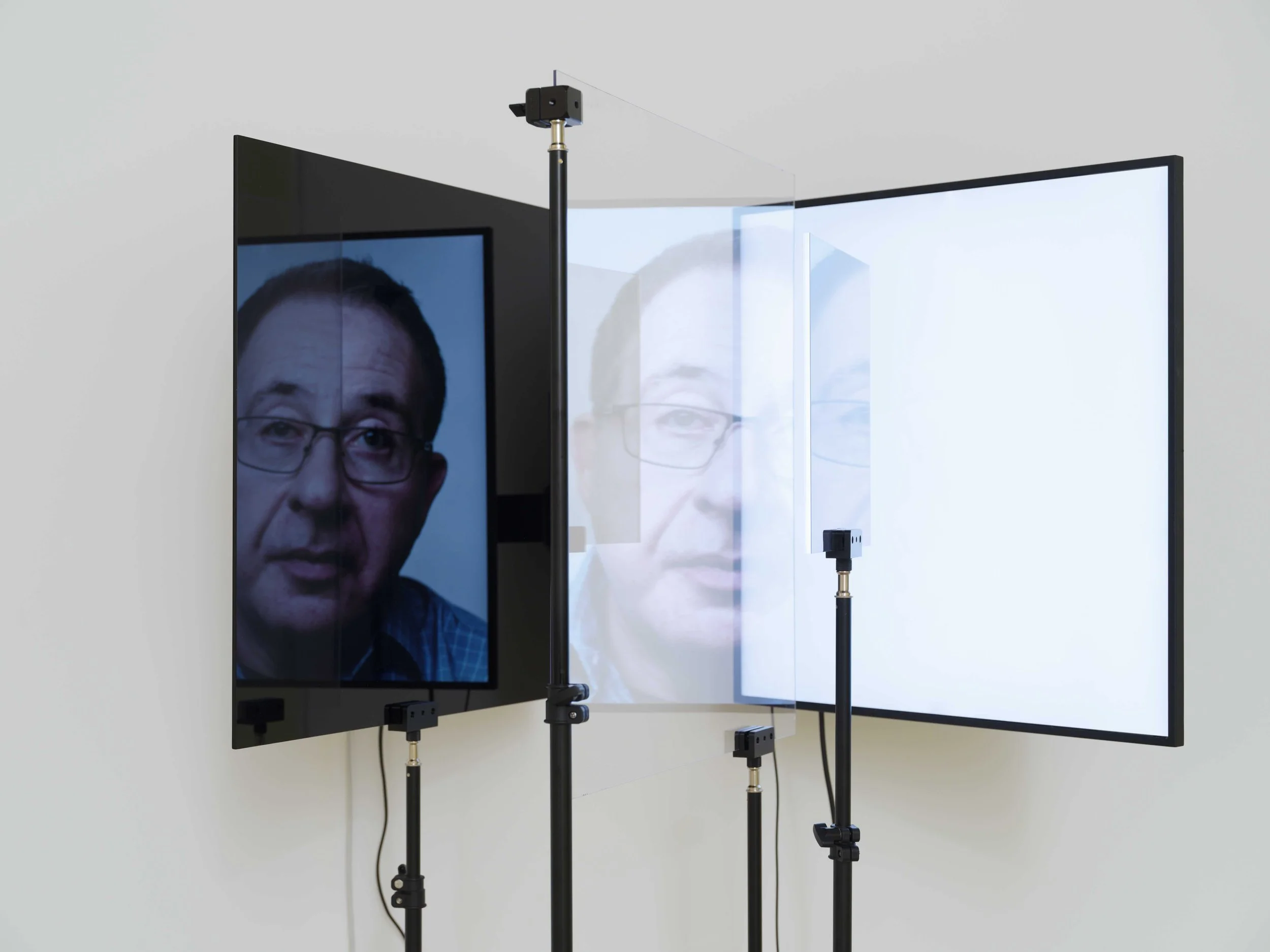
Au sein de l'exposition, les œuvres Memento 59 (Capitol Black) et Videosculpture XXVIII s'emparent de l'imagerie de l'assaut du Capitole du 6 janvier 2021 pour en déconstruire le régime de vérité. L'artiste utilise des plaques offset — servant initialement à l'impression des journaux — pour y fixer l'image d'une foule en révolte. En parallèle, une séquence vidéo de l'événement est diffusée à travers une sculpture d'écrans dont il a arraché les filtres polarisants. Exigeant un temps d'observation prolongé, ces dispositifs mettent au jour la nature construite et manipulable des images.
Emmanuel Van der Auwera présente également plusieurs pièces inédites (2025) qui intègrent l'influence des algorithmes de génération d'images, questionnant la fragilisation du standard photoréaliste comme gage de vérité.
-
Through his prints and three-dimensional installations, Emmanuel Van der Auwera questions the fabrication and circulation of information in the era of post-truth. Facing the decline of mainstream legacy media and the fragmentation of the media landscape, his artistic research sensitively articulates support and image, materiality and representation.
Within the exhibition, the works Memento 59 (Capitol Black) and Videosculpture XXVIII seize the imagery of the Capitol assault on January 6, 2021, to deconstruct its regime of truth. The artist uses offset plates — originally used for printing newspapers — to fix the image of a rioting crowd. In parallel, a video sequence of the event is broadcast through a sculpture made of screens from which he has torn the polarizing filters. Demanding a prolonged period of observation, these devices expose the constructed and manipulable nature of images. Emmanuel Van der Auwera also presents several new pieces (2025) that incorporate the influence of image-generation algorithms, questioning the weakening of the photorealistic standard as a guarantee of truth.
-
Via zijn afdrukken en driedimensionale installaties bevragingt Emmanuel Van der Auwera de productie en verspreiding van informatie in het tijdperk van de post-truth. Tegen de achtergrond van de neergang van de traditionele referentiemedia en de versplintering van het medialandschap, verbindt zijn beeldend onderzoek op sensitieve wijze drager en beeld, materialiteit en representatie.
Binnen de tentoonstelling grijpen de werken Memento 59 (Capitol Black) and Videosculpture XXVIII de beeldvorming van de bestorming van het Capitool op 6 januari 2021 aan om het waarheidsgehalte ervan te deconstrueren. De kunstenaar gebruikt offsetplaten — oorspronkelijk bedoeld voor het drukken van kranten — om het beeld van een opstandige menigte vast te leggen. Tegelijkertijd wordt een videosequentie van de gebeurtenis uitgezonden via een sculptuur van schermen waarvan hij de polarisatiefilters heeft losgetrokken. Omdat ze een langere observatietijd eisen, leggen deze opstellingen de geconstrueerde en manipuleerbare aard van beelden bloot. Emmanuel Van der Auwera presenteert daarnaast verschillende nieuwe werken (2025) die de invloed van algoritmen voor beeldgeneratie integreren, waarbij hij de verzwakking van de fotorealistische standaard als garantie voor waarheid aan de kaak stelt.